
25 Handy iPhone Apps for Businesspeople
More than 550 iPhone apps currently populate the iPhone store, and the number is constantly growing. The challenge lies not in acquiring apps, but in finding the ones relevant to your needs.
Here’s a quick-n-dirty list of some key iPhone apps for small business owners, corporate employees, and everyone in between (In no particular order. Go here for detailed reviews):
A quick and easy replacement for the traditional written mileage counter, this tool also allows you to calculate your vehicle’s fuel consumption. Handy for small business owners and anyone else who needs to report mileage.
2. Budget Tracker
This tool allows you to set a budget, then enter your expenditures into your iPhone to track how close you are to spending it all.
3. 43 Actions
The ultimate action list, this app allows you to organize actions, add new ones via email or Twitter, check off finished actions, get agendas emailed to you on a regular basis, and more.
A list of countries is available for you to instantly calculate VAT in a variety of countries. Handy for the frequent business traveler.
5. Currencies
Keep an eye on a variety of exchange rates, each equipped with a calculator that goes between your currency and the foreign one.
6. Attendance Countdown
Tracks your working hours easily and quickly. Tap on the time to specify your arrival. The app counts down how many working hours you have left, and allows you to email times for your own records or for your boss.
7. Feed Reader
This RSS feed reader comes equipped with autoscrolling to make getting your daily information fix easily and quickly.
8. Countdownr
Counts down to a date and time; for example, a birthday. Specify a daily, weekly, monthly, or annual countdown message. When the time comes, an alert goes off. Syncs with Google Calendar.
9. Worldwatchr
Allows you to view webcams of your choice directly on your iPhone. Handy for traffic and weather info.
10. Salesforce Mobile for the iPhone
Instant customer information on Salesforce.com’s mobile platform. What more could you ask for?
A cost-effective, quality voice recorder that Gizmodo loves for its pause feature.
12. Oracle Business Indicators
Business performance info at the touch of an iPhone screen, including a range of analytics. No more need to pop open the laptop before that big meeting.
13. StockWatch
Let your stockwatching obsessions flower with this standard stock app equipped with a column for your real-time gains and losses.
14. Taskr
Another task app, with an Adobe AIR desktop hookup. Easy and convenient.
15. Evernote
Evernote combines the good ol’ task-list function with notes capability and an image search. Syncs across platforms and devices.
16. SugarSync
Access your Mac or PC from anywhere, anytime, viewing and sharing a variety of files. Back up an unlimited number of computers.
17. Local city real time traffic reports
Detailed, real-time traffic conditions with all the usual radio information—what happened, how bad it is, time it happened—plus a map and GPS location.
18. Language Translator
Translates more than 20 languages through the Google language translator.
Flightstats.com data, fitted like a glove to your iPhone. Check out delay info to see if you can sleep in or languish a little longer. http://www.flightstats.com/go/Home/home.do
20. PackageTrackr
Tracks your package through UPS, FedEx, DHL, the US Postal Service, and more. Handy for planning purposes.
21. Map Mailer
Send Google maps locations via email by clicking on a map location, entering text, and sending. Emails come with links to Google Maps. Twice the accuracy and half the cell phone calls for finding colleagues and friends.
Search for jobs on the go through CareerBuilder’s website. Use geolocation to find a job near your real-time location.
23. CheckPlease
Easy restaurant price/tip calculator that spits out tip amounts and cost per person.
24. Cards
Stores credit- and ATM card details, as well as bank account information. Just don’t ever forget the encryption password—it’s not retrievable.
25. Balance
Track your budget or bank account balance. Obsoletes the manual checkbook balancing method, but doesn’t (yet) come with password protection.
[Via businesspundit]
Asus Announce Bamboo Laptops In Massive Fug Of Hyperbolic Tosh
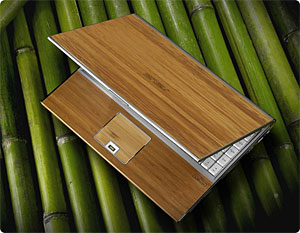
We love babbling PR tosh, so when a spectacularly ludicrous pile of techno-hyperbole oozed into our inbox from Asus, we simply had to share it with you lot.
The company wrote to tell us all about their ‘Bamboo Series’ of laptops - consisting of 12.1″ and 11.1″ models powered by Intel Core 2 Duo-powered processors - which are being trumpeted as “spurring the Green Computing Revolution,” no less.
But these are no ordinary laptops - no sir!
Regaling in ‘artisan-grade Moso bamboo paneling’, Asus insist that their mix of “organic tactility, refreshing scent and minimalist aesthetics” apparently gives the laptops “an arresting aura of spirituality, warmth and old world charm that synthetic materials and cold, impersonal metals will struggle to replicate.”
And there’s more, with Asus getting all poetical about what it’s like to touch the laptops. Get a load of this trumpery:
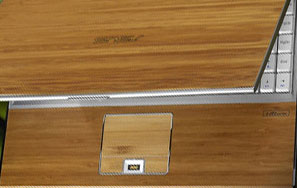
“With every touch, users will be able to feel the difference – the bamboo gives an instant sense of familiarity, just like the sensation one would get from running one’s fingertips across furniture. The sensation of being close to nature is even conveyed when users use the touch pad. The genuine bamboo fiber patterns on the touch pad create the sensation of touching live bamboo.”
 Asus are so hyped up about their green credentials that they’ve taken to dishing out lectures to others: “For solution providers, the key to going green entails looking beyond mere legal compliance and proactively inculcating green values among staff. ASUS is the beacon of success for this approach.”
Ya. Rly.
Once we’d had a little bit of a sit down to recover from the pungent whiff of wafty PR nonsense, we took a closer look and found that there’s quite a lot to like about these laptops.
 For starters, they look great. Compared to the usual dull black boxes and shiny silvery concoctions knocked out up by trendy laptop makers, the Asus laptops have a refreshingly natural look - although we wouldn’t go as far as ascribing any kind of spirituality to the things. Well, not unless we’d been on some particularly potent drugs.
Lurking inside the 12.1 screen model there’s a choice of Intel T9400/P8600/P8400 Core 2 Duo processors, 256MB nVidia GeForce 9300M GS graphics with up to 4GB of Dram, backed by a 320GB hybrid hard disk drive with 256MB of Flash, with the smaller 11.1″ screen lappie offering a regular 80-120GB HDD and a 32GB SSD.
Both laptops use Asus’ new Super Hybrid Engine power-saving technology which promises an increased battery life of some 35-75% against similarly spec’d notebooks. Very nice.
We’ve no idea on pricing yet, but we suspect all that panda-depriving bamboo is going to hike the retail price in an unpleasantly upward direction.
iPhone girl scared by attention
 Mystery girl befuddled by worldwide fame
Written by Iain Thomson in San Francisco
A Chinese factory worker who became an internet sensation after a photo of her flashing a peace sign was left on an iPhone has been identified.
The photo was left on an iPhone delivered to a British customer who posted it up on an Apple message board. Since then the photo has gone around the world and people have tried to identify the mystery worker.
Foxconn, which makes the iPhone for Apple, has now confirmed the girl has been identified but says her job is not at risk and has called the incident a “beautiful mistake”.
However the girl herself is more than a little perturbed by the reaction to the picture.
“"She's just a young girl who has come to the city from her remote hometown. She's never been in such a situation,” a Foxconn representative told the South China Morning Post.
“She's really scared by the media. She told me she wanted to quit her job and go back home to get away from this. We let her off work today so she could rest. "
Via www.vnunet.com
Sony to launch world's thinnest LCD TVs
 TOKYO (Reuters) - Sony Corp said on Thursday it would launch the world's thinnest liquid crystal display (LCD) TVs this year, broadening its product line-up ahead of the critical year-end shopping season.
The new 40-inch model, which is 9.9 mm thick, is estimated to sell for 490,000 yen ($4,478) in Japan, Sony said.
The Japanese electronics and entertainment conglomerate will also offer the world's first LCD TVs that display 240 frames per second, compared with 120 frames for Sony's existing models.
More frames in a given time make fast-moving images in sports programs and action movies look seamless.
Sony, the world's second-largest LCD TV maker behind Samsung Electronics Co Ltd expects a 46-inch model with the 240 frame function to sell for around 400,000 yen.
Both models will go on sale in Japan on November 10, closely followed by overseas launches.
Sony said a slowing economy has had little effect on its LCD TV sales, and that the maker of Bravia brand flat TVs is on track to hit its target to sell 17 million LCD TVs in the year to March 2009.
Sony shares were down 0.7 percent at 4,140 yen, outperforming the Tokyo stock market's electrical machinery index IELEC. which fell 1.1 percent.
(Reporting by Kiyoshi Takenaka)
Source: Yahoo News
A $130 phone headset helpfully talks back
 NEW YORK - Bluetooth wireless headsets for mobile phones are puzzling: We're supposed to control them with couple of unmarked buttons and get feedback from a single indicator light.
What is the headset trying to say when the LED is blinking that particular way? How do I connect it to a new phone? Do I press the big button or the small button, or both at once? The user interface is as cryptic as an alien artifact.
On Tuesday, BlueAnt Wireless launched the first headset that, by comparison, is clearly from Planet Earth. The $130 V1 headset recognizes spoken English commands, and responds, also in English.
It's eerily like having an automated call center in your ear. It can't do everything that a standard headset combined with a voice-recognizing phone can do, but it's a useful advance for an industry that's been focused on everything except ease of use.
Headsets are marketed based on how much ambient noise they suppress, how small they are and how long their batteries last. Yet Shawn Score, president of Best Buy Mobile, says 20 percent of the Bluetooth headsets it sells are returned. When the Best Buy employees "pair," or connect, a new headset to the customer's phone in the store, the return rate drops to a few percent. Clearly, a lot of people find these things hard to set up, and I don't blame them.
If you haven't memorized the procedure for entering pair mode with a regular headset and don't have the manual handy, good luck. Burning incense or tossing some salt over your shoulder might help.
With the BlueAnt V1, this is what you do: Press the big button once. A male voice says "Say a command." You say "Pair mode." Then the voice walks you through what to do on the phone to get it connected.
If you've forgotten the magic words, you press the button and ask "What can I say?" The V1 will patiently go through the commands it accepts. You can ask it whether the headset is connected to the phone, and how much battery charge is left.
When you get a call, the headset reads out the number, then asks whether you want to answer or ignore it. You don't need to touch the headset, as you do with competing models. Don't worry — people around you will get used to you blurting out "Answer!" Remember, years ago people who talked loudly to unseen friends while walking down the sidewalk were considered crazy.
So far so good. But the headset is quite limited in the number of terms it can recognize, and you can't train it to recognize or say new phrases. This means that when you receive a call, it will read out the number, digit by digit. It can't tell you "It's your wife calling again."
Another big limitation is that you can't dial calls from the V1 by saying the name of someone in your phone's contacts list.
You can, however, program seven numbers that it can call for you. Some phones allow you to program a speed dial for each number, from 1 to 9, and the V1 can use those — but it reserves 1 for voicemail and 5 for Google Inc.'s 411 service. So you can tell it "Call speed dial six" and it will do so.
Not all phones allow these sorts of speed dials. Apple Inc.'s iPhone 3G is an example. In those cases, you have to get a call from a number before you can store it in the headset's own speed dial list. Then you have to press the "Volume Down" button on the headset to store it. This isn't exactly a usability advance over standard headsets.
If you have a phone that takes voice commands, those will work with the V1 as well. Since the headset can do things the phone can't, and vice versa, this is a good combination. When I tested this with a BlackBerry Pearl, pressing the phone's voice command button elicited a female voice in my ear, asking me what I wanted to do. When I pressed the V1's button, I got the male voice. It was almost like being 2 years old again and having my parents at my beck and call.
In other ways, the V1 behaved like a good, standard headset. It was comfortable to wear. Apart from the big "command me" button, there are two volume buttons. The rated talk time is five hours.
In loud environments, the V1 did nearly as well as the latest Jawbone headset from Aliph (also $130), which prides itself on military-grade noise suppression. Both are good enough that your main problem is likely to be the sound of the wind whistling over the microphone rather than ambient noise.
The V1 costs twice as much as an older BlueAnt headset without voice recognition, but my guess is you'll find it a good value, particularly if your phone lacks voice recognition.
The voice-recognition feature won't be unique to BlueAnt — it's provided by a third party, and it will probably show up headsets from a few manufacturers within a year. Beefing up the voice recognition to make it more versatile likely will take a few more years, but it won't be long before we can tell a headset to "Call my office and tell them I'll be in at 10, then book me a massage for 9, m'kay?"
Source: Yahoo News
See also:
Daimler denies planning second Smart car plant
New Zealand's colossal squid defies legends: scientists
Some eBay sellers frustrated with rule changes
Nokia unveils new multimedia phones
 HELSINKI (Reuters) - Nokia (NOK1V.HE) unveiled two new high-end phone models, the N79 and the N85, as the world's top cellphone maker battles against increasing competition from the likes of Apple (AAPL.O) and Samsung (005930.KS).
Both new phones, upgrades to Nokia's older models, will have 5 megapixel cameras and pre-loaded games.
Both new models will go on sale in October. The N85 will retail for 450 euros ($662), excluding operator subsidies and taxes, and the N79 will go on sale for 350 euros.
Shares in Nokia were 1.8 percent higher at 17.63 euros by 0852 GMT, outperforming a firmer DJ Stoxx European technology shares index (.SX8P).
(Reporting by Tarmo Virki, editing by Will Waterman)
Source: yahoo news
Vocal joystick gives computer control to those with disabled hands
SEATTLE--For many Iraq war veterans who have returned home with debilitating injuries that, for example, make it impossible to use their hands, doing anything on a computer is an impossible task.
But a research project being worked on in the Electrical Engineering department at the University of Washington could be the latest tool at such veterans' disposal, as well as anyone who suffers from the lack of full use of their hands.
The project, known as the Vocal Joystick, which, according to University of Washington graduate student Jon Malkin, is an extension of speech recognition technology, is designed to allow someone to control a computer cursor using nothing more than their voice.
Malkin gave a talk on the project at the Gnomedex conference here Saturday.
It works by having a user train the Vocal Joystick software with his or her voice, mainly using the mouth and lips.
"We can do a lot with that," Malkin said. "Speech is a very complex signal."
Indeed, he explained that the software allows a user "four degrees of freedom" meaning that the cursor can be moved up, down, left and right, all with different vowel sounds.
For example, to move left, the user would sound out the "ee" tone in "feet." To go right, it would be the "aw" sound in "law." Hitting the equivalent of the mouse button would be the "u" sound in "but."
It might be tempting to think that only the most basic tasks are possible with this kind of software, but Malkin said that one artist who has used the Vocal Joystick had employed it to paint a picture of Mount Fuji that he then showed the audience.
The picture was very good, something many people with full use of their hands would never have been able to make.
He said the artist had made the picture in just three hours.
Malkin also demonstrated the software in real-time, showing how it is used in conjunction with a simple game where a player controls a fish swimming around trying to catch other fish.
He proceeded to sound out vowel after vowel, and sure enough, on-screen, his fish moved around dexterously, chomping up snack after snack. The Gnomedex crowd went wild.
Source: Yahoo News
See also:
New Theory on DEET: Mosquito Just Dislikes It
Aboriginal Kids Can Count Without Numbers
New Zealand's colossal squid defies legends: scientists
New Google box for offices can search 10 mln files
SAN FRANCISCO (Reuters) - Google Inc (GOOG.O) said on Tuesday it is an offering an upgraded version of the hardware appliance its sells to companies and government organizations for Google-style Web search of office documents.
The Web search leader said the latest version of the Google Search Appliance, a pizza-sized box that holds a self-contained search system for managing an organization's electronic files, can store up to 10 million documents in a single box.
The new product has the same capacity as a previous version that came in a five-box rack. Google already sells a 12-box version of the appliance in a rack the size of a stand-up refrigerator that can search up to 30 million documents.
The appliances contain Google software to power the search services, running on storage hardware from Dell Inc (DELL.O).
Once installed in a network, the appliances help staff find documents in various different corporate store houses, from EMC Corp's (EMC.N) Documentum, IBM's (IBM.N) FileNet, Open Text's (OTC.TO) LiveLink and Microsoft Corp's (MSFT.O) SharePoint.
New features in the latest model include greater encryption powers and the ability for Google Alerts to notify users when new documents are stored on the network by colleagues.
Network administrators will be able to manage Google Search Appliances in 27 languages, adding Turkish, Czech, Vietnamese and Portuguese. The boxes can, in turn, deliver search results to office workers in 40 different languages.
Mountain View, California-based Google does not disclose revenue for search appliances, which are part of its enterprise software and services business aimed at corporate buyers.
Roughly 98 percent of its revenue comes from advertising sold alongside services on Google.com and affiliated sites.
But because Google does not reveal revenue for the business, it is hard to verify its claims to be the market share leader in enterprise, as well as consumer, search.
"We estimate, with obviously imperfect information, that we are the market leader," Matt Glotzbach, product management director for Google Enterprise, said in a phone interview.
Rival providers of search used inside company networks include Microsoft, IBM, and Autonomy (AUTN.L) of Britain.
(Editing by Braden Reddall)
Source: YN
See also:
Memory, Depression, Insomnia -- And Worms?New Wind Power Tech Has Old-Fashioned Roots: Time Machine (November 1974)
Beijing blanketed by smog three days before Olympics
Dell tests music player to renew iPod battle: report
BANGALORE (Reuters) - In recent months, personal computer maker Dell Inc. (DELL.O), has been testing a digital music player that could go on sale as early as September, the Wall Street Journal newspaper said, citing several Dell officials.
Dell's new foray would put it into an Apple-led (AAPL.O) market that has defied assaults.
Companies like Microsoft Corp (MSFT.O) and Sony Corp (6758.T) have tried -- and failed -- to make a dent in the market dominated by Apple's iPod players and iTunes store, the Journal said.
The music player which Dell has been testing features a small navigation screen and basic button controls to scroll through music play lists, the Jornal reported.
It would connect to online music services via a Wi-Fi Internet connection, and Dell would likely price the model at less than $100, the Journal said. Dell's first foray into the music market in 2003 was a huge disappointment. It withdrew from the music-player market after its DJ Ditty player failed to make major inroads.
This time, if the company goes ahead with the music player, the strategy is different, Michael Tatelman, Dell's vice president of consumer sales said, according to the paper.
Instead of simply selling a piece of hardware tied to someone else's music service, as it did in 2003, Dell is working on software for a range of portable PCs that will let users download and organize music and movies from various online sources, the paper added.
(Reporting by Purwa Naveen Raman in Bangalore)
Source: YN
See also:
Kenya energy goes green to meet electricity boom
Oldest New Testament Bible heads into cyberspace
New uranium leak discovered at French nuclear site
New Cell Phones Help Keep You Healthy
Cell phones have always been about helping you keep in touch. Now they're helping you stay healthy.
Eager to discover the next new trend in cell phone technology, Japanese mobile carriers are developing and rolling out services that tie a user's desire to keep fit with their cell phone and network-linked services.
First off the starting block has been KDDI's Au unit, which launched a service earlier this year called Smart Sports.
Most of its new handsets incorporate the service to some degree but three recently-launched models are fully equipped to take advantage of the technology. Inside the phones, a motion sensor and GPS (Global Positioning System) work together so that when you're running, the number of steps taken, distance, and calories burned are measured and recorded-- and the phone does this even if the phone's dedicated "Run&Walk" application isn't launched.
When you're done work-out information can be sent to a server and later your run can be mapped and analyzed through a PC.
And because the beat of music can help you during your daily exercise, the service links in with Au's "Lismo" music download service and can send selected tunes to a pair of wireless headphones. Using the "Beat Run" playback mode, it will also match musical tracks and the pace of the exercise.
The Smart Sports Web site indicates 7,200 users worked out with the service on Sunday and that in total this month 54,000 users have racked up more than 1 million [m] kilometers of running and walking between them and burned a collective 38 million [m] kilocalories.
Rival carrier NTT DoCoMo is also developing health-related applications.
Its system has weighing scales or blood-pressure monitors sending data to a user's cell phone via Bluetooth. DoCoMo is hoping to get organizations like health clubs and hospitals to participate so that automatic monitoring of basic wellness data can be easily done-- with the user's consent of course.
The system isn't commercialized yet but NTT DoCoMo hopes to have it available some time in the next year.
Source: PCWorld
See also:
Blu-ray Disc Rapidly Gaining Popularity in Japan
National park in Alaska tests hybrid bus
A Better Solar Collector
Blu-ray Disc Rapidly Gaining Popularity in Japan
Shipments of Blu-ray Disc-based video recorders and players are increasing fast in Japan as the market rallies around the format after the end of its battle with the defeated HD DVD format.
Shipments of recorders and players based on Blu-ray Disc hit 122,000 in June marking the first time that monthly shipments have broken into six-figures, according to data published on Tuesday by the Japan Electronics and Information Technology Industries Association (JEITA). The data is gathered from member companies, which include all the major consumer electronics manufacturers in Japan.
That figure is a healthy jump on the 82,000 units shipped in May and is likely due to anticipated demand for the devices going into July, when millions of Japanese workers receive a mid-year bonus, and August, when the Olympics are held in Beijing. Both events typically provide a boost to the consumer electronics sector.
The sector was also boosted by the July 4 launch of a new system called "Dubbing 10" that allows consumers to make copies of TV shows they have recorded. In the past consumers were able to make one digital recording of a TV show but not make subsequent copies of that recording. The new system, which required new firmware or updated machines, allows up to 9 additional copies to be made and its arrival had some consumers holding back on purchases.
Because of the widespread availability of high-definition digital TV Japanese electronics makers are pushing Blu-ray Disc recorders that, in many cases, are combined with hard-disk drive recording capability.
A quick check of comparison shopping Web site Kakaku.com shows the cheapest Blu-ray Disc machine, Sharp's BD-AV1, can be found for ¥44,800 (US$420). The machine, which doesn't include HDD recording, is typically priced at between ¥55,000 and ¥65,000 at many retailers.
The cheapest machine with HDD recording that is widely available is Sony's BDZ-T50, which packs a 250G-byte drive that can accommodate about 50 hours of HDTV. The recorder, which was first released in November 2007, costs as little as ¥71,180. That's about half the original list price of ¥140,000.
However, buyers need to be wary of purchasing older machines that, in some cases, don't support the latest version of the Blu-ray Disc format. The Sharp BD-AV1, for example, won't record to the newer 2-layer Blu-ray Disc media although it does offer playback. That means owners are limited to single-layer 25G-byte discs that hold about 3 hours worth of HDTV.
No major vendor has released a playback-only Blu-ray Disc machine in the Japanese market.
Japan domestic shipments of Next-generation optical disc recorders/players
Month Jan 2008 Feb 2008 March 2008 April 2008 May 2008 June 2008
Shipments 35,000 58,000 77,000 81,000 82,000 122,000
Source: Japan Electronics and Information Technology Industries Association
See also:
Daily Gadgets
New Worm Transcodes MP3s to Try to Infect PCs
Australia unveils online code of conduct
Wireless company to allow other carriers' devices
NEW YORK - MetroPCS Communications Inc. has become the largest U.S. wireless carrier to say it will let customers bring cell phones from other carriers, which it will then reprogram for use on its own network.
This week's announcement by the Dallas-based regional carrier is one of a series of moves in the industry that amount to a gradual opening of the U.S. wireless market, giving consumers more choice over what phones to use on what networks.
Carriers generally sell phones that are locked to their own service. This protects their business model, which is based on subsidizing the cost of the phone by hundreds of dollars, then making that money back on monthly service fees.
MetroPCS's move threatens these traditional rules. It allows customers with certain models of phones from Sprint Nextel Corp., Verizon Wireless, Alltel Corp. and a few other carriers to bring their phones to MetroPCS stores, where they will be reprogrammed.
Phones from AT&T Inc., T-Mobile USA or other providers that use a technology known as Global System for Mobile, or GSM, won't work on MetroPCS's network. It is already possible to bring an unlocked GSM phone from, say, T-Mobile, and have it activated on AT&T's network, but AT&T won't unlock the phone for you.
A smaller carrier, Pocket Communications, reprograms phones for customers. Its network covers the San Antonio area.
MetroPCS's network covers 14 large cities, including Miami, Atlanta, Dallas, Detroit, Los Angeles, San Francisco and Las Vegas. It had 4.4 million subscribers at the end of March.
Its network uses the Code Division Multiple Access, or CDMA, technology. CDMA carriers maintain databases of the serial numbers carried by phones that they have sold, and except for Pocket and now MetroPCS, won't activate phones with other numbers. They generally say that they won't let any phones on to their networks without putting that model through rigorous testing. This applies even to phones that are functionally identical to their own, like the many slight variations of the Motorola Razr sold by different carriers.
Consumer groups have been fighting the locking of phones and exclusive agreements between manufacturers and carriers that, for instance, restrict Apple Inc.'s iPhone to AT&T Inc.'s network.
Apart from locking the phones, carriers protect their business model by signing customers to two-year contracts, and charging an early termination fee if they break it. MetroPCS's move does not change that fact, but major carriers have been reducing their early termination fees this year, prorating them depending on how long a contract has been in force.
Source: yahoo news
See also:
Personal security in the palm of your hand
Dual-display e-book reader lets you flip pages naturally
Get your new Phone and get connected now. (see offer for details)
Medical Nano-Bots Utilize Sperm Tails For Propulsion
Delivering medicine with tiny robots inside your veins

Imagine a tiny robot or drug-delivery device that could swim through your veins, using blood sugar as its fuel. Such a device could be powered by the same chain of chemical reactions that propel sperm toward an egg, according to researchers at Cornell University.
The researchers are trying to reproduce (pardon the pun) the steps whereby a sperm's whiplike tail generates energy. (Sperm also generate energy using the mitochondria in their midsection.) Running the length of the tail is a fibrous sheath with 10 enzymes attached to it. These enzymes act in series to break down glucose into ATP, the energy source for cells, in a process known as glycolysis.
So far, the Cornell researchers have managed to attach three of the 10 enzymes to a computer chip and confirm that the enzymes still work. If they can attach all 10 enzymes, they'll have a working version of a sperm engine, which could then be attached to nano-devices. The researchers presented their findings at the American Society for Cell Biology's annual meeting today.—Dawn Stover
See also:
NASA Jumps at Patent for Plasma-Powered UFO Technology
Smartpen Could Change Note-Taking ForeverRobot Round-Up
New Flying Saucer Runs on Plasma

A flying saucer is in the works, but it didn’t come from space. It came from Florida.
Subrata Roy, an engineering professor at the University of Florida, is trying to patent his design of a circular, spinning aircraft he dubs WEAV, short for wingless electromagnetic air vehicle.

The suggested prototype offers several advantages. It can hover and take off vertically. With no moving parts, the WEAV should be markedly reliable. And though his battery-powered model is only six inches across, Roy thinks a larger craft is possible.

Roy applied his experience doing U.S. Air Force-funded plasma research to develop the propulsion system devoid of typical aircraft parts such as propellers and engines. Here is how it works: Electrodes lining the vehicle’s surface ionize the surrounding air. This creates plasma on the vehicle’s exterior. An electrical current sent through this plasma generates a force that not only produces the necessary lift and momentum. It also stabilizes the vehicle in windy conditions.
Looking like a flying bundt pan, the WEAV design is partially hollow and continuously curved. This larger surface area improves lift and control.
Besides providing surveillance on Earth, Roy also envisions the craft in other atmospheres, such as that of Saturn’s moon Titan, where high air density and low gravity would be favorable to saucer flight.
But the path from concept to production may not be smooth. Flying in Earth’s air requires a thrust at least 10 times greater than in outer space where drag and gravity are lower. And the plasma necessary to fly also obstructs wave transmission used for communicating with a remote source.
This doesn’t discourage Roy. “Of course the risk is huge, but so is the payoff,” he said. “If successful, we will have an aircraft, a saucer and a helicopter all in one embodiment.”
See also:
Electricity in the Air: The Future Wireless World
Regenerating Lost Cartilage
Salmon Sperms Bright Future: BioLEDs
A Fabric That Will Charge Your Gadgets

Forgot your charger? No problem. Scientists have developed a microfiber fabric that can generate enough electricity to juice up a cell phone or a mini-music player. If turned into clothing, the fabric would get its power from the action of your daily movement. The material uses zinc-oxide nanowires that are arranged in pairs—one wire in each grouping is coated with gold, and serves as the electrode. When the fabric moves, the wires move and bend, and the fabric translates this mechanical energy into electricity.
A report on these so-called fiber-based nanogenerators was just published in Nature. The scientists say there are still a few technical hurdles. One problem: You might not want to throw a power shirt in the wash. Lead researcher Zhong Lin Wang of the Georgia Institute of Technology says zinc oxide is sensitive to moisture, so you’d need to find some way to protect the nanowires before they’d be ready for the washing machine.
Via ZDNet
See also:How It Works: The Endoscope Camera in a Pill
Can You See Sperm Of The Salmon On your Display? But it is :)
The Flight of Dragonfly Robots
Finally a useful digital pen
 NEW YORK - The pen, once mightier than the sword, has been getting trounced by the keyboard in the computer era. Now and then there's a push toward "pen-based computing" that doesn't get very far.
But in a test of the latest crop of pens that combine ink with digital technology, at least one stands out as a useful tool and a complement to the keyboard.
All three pens I tested record what the user writes, and can transfer an image of those notes to a PC. The standout of the group is the LiveScribe Pulse, which also records audio as you're writing. Later, you can tap a place in your notes, and the pen will play back what it was hearing when that was written.
As you can imagine, this is something of a Holy Grail for journalists, who run around with notepads and voice recorders. A classic problem for us is finding the right place in an audio recording without listening through the whole thing. The Pulse solves this problem.
Students also should pay attention to this pen. There is probably no better gadget for taking notes in class, except perhaps a Tablet PC, which allows you to write on the screen. But Tablet PCs are expensive and more difficult to use than the Pulse, which works with standard Windows PCs. You can also use it in a more limited fashion without a PC.
A Pulse with 1 gigabyte of memory costs $149 from LiveScribe's Web site. A model with twice as much memory costs $199, but the cheaper model has room for 35 hours of audio at the highest quality setting, or more than 100 hours at a lower setting, so it's a good value.
The greatest limitation of the Pulse is that it only works with special paper, preprinted with a pattern of dots. These are picked up by a small camera in the pen (this is the reason the pen is about as thick as a cigar), which lets it figure out where it is on a page. The pen comes with a 100-sheet college-ruled notebook. You can buy a four-pack of additional notebooks from the site for $19.95. Later this summer, LiveScribe hopes to make it possible for users to print their own paper.
The dot-sensing technology in the pen comes from a Swedish company, Anoto, and has been incorporated in a number of pens from other companies.
Another example is the Nokia Digital Pen SU-27W, which uses Bluetooth technology to transfer notes to a cell phone. Dash off a message on one of the small notepads that come with the $299.95 pen, and you can send it as a text message or as picture message through the phone.
The utility of this is hard to grasp. For your note to be converted to a text message, the phone needs to guess at what your handwriting means. If you use block letters, it does a decent job, but any sort of cursive will confuse it, and no wonder — even powerful computers can have a hard time interpreting handwriting.
You can bypass the text conversion by sending the note as a picture, but you really don't need a $299.95 pen and a special notepad to do that, just a cell-phone with autofocus camera. Write your note on any kind of paper, photograph it and send it off. Not as legible as text message, but more personal, for sure.
The Nokia pen can also transfer the notes to a PC, and does a decent job of this, but I really missed the audio-recording feature of the Pulse.
The third pen, the Iogear Mobile Digital Scribe, uses a completely different technology. It doesn't need preprinted paper. Instead, you attach a small "clip" with an LCD screen to the notepad you're using. The pen, which is the size of a regular ballpoint, signals its position to the clip using ultrasonic pulses and invisible infrared light. Connect the clip to your computer to transfer the notes.
The major virtue of this is that it can be used with any notepad. But as with the Nokia pen, the utility is questionable. If you need to save your notes on the PC, you can photograph them or scan them without using a digital pen. The pen does make the process easier, and the notes are clearer, but here and there I found that the clip missed part of a letter.
By tethering the clip to the computer, you can use the pen to control your mouse cursor, much like the dedicated pen tablets graphics artists use. This looks fun, but again, it's not very useful, and dedicated tablets do a better job.
The software that comes with the $129.95 Digital Scribe had the supremely annoying habit of launching when the computer started, and sending up an alert bubble every time, saying that the clip was not connected. This feature could not be turned off.
The LiveScribe Pulse software also had some odd limitations. I was unable to install it on my work computer because the "My Documents" folder was on another computer in the network. There's no way to convert the notes into a text file, or turn notes into e-mail, but you can upload your notes to LiveScribe's Web site to share them, with audio included. The LiveScribe, like the other pens, comes with Windows software only.
But at least the Pulse demonstrated that pens can still be relevant. Sure, you can bring a laptop to a lecture to take notes, but that means you need one eye on the screen. When writing by hand, it's much easier to pay attention to the speaker (and you can draw diagrams too). This is even more important in interviews, where taking notes by hand allows you to maintain more eye contact. Even in a digital world, that's important.
See also:
Livescribe's Voice- and Camera-Based Pulse Smartpen Could Change Note-Taking Forever
4 Totally Weird Korean Gadgets (That Might Be) Coming Stateside Soon
The Next 5 Extreme Research Machines You Need to Know
Nanowire 'Paper Towel' Designed to Clean Up Oil Spills
Link of the day: Need to make an extra $5000 per month? Google PayDay software makes it so easy! Free download! A mat of nanowires with the touch and feel of paper could be an important new tool in the cleanup of oil and other organic pollutants, scientists announced today.
MIT researchers and colleagues say they have created a membrane that can absorb up to 20 times its weight in oil, and can be recycled many times for future use. The oil itself can also be recovered.
Some 200,000 tons of oil have already been spilled at sea since the start of the decade.
"What we found is that we can make 'paper' from an interwoven mesh of nanowires that is able to selectively absorb hydrophobic liquids - oil-like liquids - from water," said Francesco Stellacci, an associate professor in the Department of Materials Science and Engineering and leader of the work.
The results are detailed in the May 30 online issue of Nature Nanotechnology.
In addition to its environmental applications, the nanowire paper could also impact filtering and the purification of water, said Jing Kong, an assistant professor of electrical engineering in the Department of Electrical Engineering and Computer Science and one of Stellacci's colleagues on the work. She noted that it could also be inexpensive to produce because the nanowires of which it is composed can be fabricated in larger quantities than other nanomaterials.
Stellacci explained that there are other materials that can absorb oils from water, "but their selectivity is not as high as ours." In other words, conventional materials still absorb some water, making them less efficient at capturing the contaminant.
The new material appears to be completely impervious to water. "Our material can be left in water a month or two, and when you take it out it's still dry," Stellacci said. "But at the same time, if that water contains some hydrophobic contaminants, they will get absorbed."
Two key properties make the system work. First, the nanowires form a spaghetti-like mat with many tiny pores that make for good capillarity, or the ability to absorb liquids. Second, a water-repelling coating keeps water from penetrating into the membrane. Oil, however, isn't affected, and seeps into the membrane.
The membrane is created by the same general technique as its low-tech cousin, paper. "We make a suspension of nanowires, like a suspension of cellulose [the key component of paper], dry it on a non-sticking plate, and we get pretty much the same results," Stellacci said.
In a commentary accompanying the Nature Nanotechnology paper, Joerg Lahann of the University of Michigan concluded: "Stellacci and co-workers have provided an example of a nanomaterial that has been rationally designed to address a major environmental challenge."
See also:
New Nanowire Battery Life Reaches From iPods to Electric Cars
Nanowires for Displays
Scientists Build Nano Hot Rods